
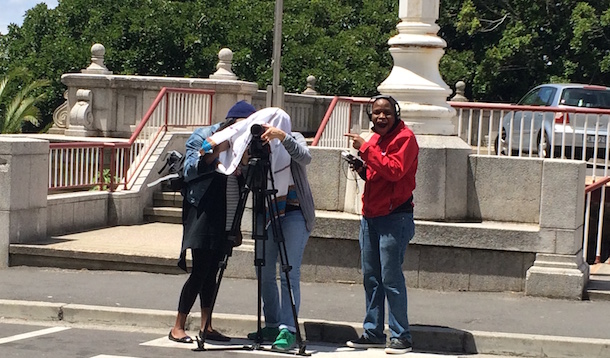
When producing a MOOC remember: keep calm and check the schedule! 

UCT moocs video production

For the past three months I’ve worked as the video production manager on the University of Cape Town’s Massive Open Online Courses (MOOCs) team. UCT’s first MOOC, entitled Medicine and the Arts: Humanising Healthcare, is an interdisciplinary course bringing together academics from the arts, humanities and healthcare to teach a course in the Medical Humanities.

My role included coordinating thirteen academics around our four-week shooting schedule – no easy task – totally worth it! 

We had a great group of people, personalities and scholarship. Being part of the production process was like being in a classroom with some of UCT’s finest minds. I had first hand access to illuminating ideas about how our bodies are understood in the context of medical practice, how conception may be the single most creative act ever, and discovered in UCT’s second MOOC What Is A Mind? that a thumb-sized part of our brains is the seat of all consciousness, and the little dictator of emotions and actions really does make us human. 

When not on set helping to manage the studio floor I was engaged in consistent communication between our team, course conveners and academics by email, sometimes face-to-face meetings, as the course design was put in place and developed. 

I’m happy to have gained access for the team to shoot inside the medical contexts which the course explores. Like the Khayelitsha District and Red Cross War Memorial Children’s Hospital, the Heart of Cape Town Museum housed at Groote Schuur Hospital, and the Irma Stern Museum. Cold calling, what cold calling? Luckily for me the University of Cape Town has great working relationships with some of the most esteemed institutions in the province. 

The film-making process is no doubt a team effort, and what I learnt through my time at the Centre for Innovation in Learning and Teaching (CILT) is that so is the business of creating a course! What a wonderful, smart and fastidious group of people are behind the MOOCs Implementation Team – a group of people committed to making outstanding UCT scholarship available to anyone, anywhere in the world. They know the need that exists in developing nations for the fair distribution of open educational resources. Africa is on the MOOC map of knowledge producers thanks to their efforts. Our time is now.

So, when you get around to producing your own MOOC remember: keep calm – and just check the schedule!

Why MOOCs Matter to Us

UCT MOOCsUCT MOOCs

It is no longer the Year of the MOOC and that glow of promise from MOOCs as the medicine to cure all the ills of higher education has faded away. In fact, there are sober findings from less hyped and more robust studies emerging which indicate that MOOCs are serving an existing over-subscribed group of male graduates from the global north and that access to and for the world’s poorest countries has been low. Turns out the quality is as good or as bad as any other course. (And we won’t talk about completion rates!) With the discourse largely about business models rather than pedagogical models, should we not shrug and turn away? We weren’t the ones innovating in Canada and we didn’t get the capital to venture into something new and different, so should we even join the bandwagon at all?

Actually, yes.

MOOCs have been the lightning rod that draws attention to a whole range of inter-related issues about online learning and about open education. They have become a kind of shorthand for all sorts of complicated “ingewikkeld” educational matters. So this is why I think that educators, researchers and universities in developing countries, and in the less well resourced parts of developed countries, should be thinking about and planning and conceptualising MOOCs.

  • Because engaging with MOOCs gives us an entry to talking about online learning and about learning and about course and curriculum design with people with whom we have not had those conversations before. And many of us who have been working in the trenches know a lot about these teaching and learning issues.
  • Because we consider MOOCs as one possibility in a whole basket of emergent online possibilities: in addition to traditional formal online courses, there are open boundary courses, wrapped MOOCs, SPOCs and who knows what else will come into being as we try things out.
  • Because we do want access to all that interesting new stuff that is being made available freely online for those of us with the capacity to access it. It’s great being exposed to so much stimulating material so easily. And preferably we would like it licensed in ways that would allow us to adapt for local use.
  • Because we are fed up the global north’s domination of online content and fear that MOOCs will only make that worse. So we want to get our own resources online.
  • Because we know that there are numerous topics – from archaeology to health to literature – of general international and niche interest that we are in the best position to teach and make widely available. (And it depresses us that the first MOOC on African cities is being offered by a French institution.)
  • Because we think we are as creative and imaginative as anyone else in the world, and have exciting ideas to offer.
  • Because we take that third university pillar of social engagement and community service really seriously. The development mission is a genuine imperative for many of us; MOOCs and other forms of online learning and open learning can serve that commitment very well.
  • Because we are excited about the pedagogical possibilities and look forward to experimenting in local conditions.
  • Because engaging in the non formal and non traditional space can be liberating and exciting, even as we are mindful that online experimentation of this kind is exposed and transparent.
  • Because being a late adopter means we get to benefit from some real and robust research, not just the hype of the early days.

We take the innovation aspect of our mandate very seriously and are delighted that our university, UCT, has committed support- both practical and symbolic – for the development of MOOCs.